Delicate, designer and unlabeled fabrics
The most important page on this site, because in this town the furniture is frequently worth more than the cleaning, and being wrong cannot be undone.
Calls answered 7am to 8pm · same-day service usually available
Send a photo of the fabric and the tag if there is one. We will tell you before you book.
The codes, and why they matter so much here
| Code | Means | What going wrong looks like |
|---|---|---|
| W | Water-based cleaning is safe | Forgiving, though over-wetting still causes wicking |
| S | Solvent only, no water | Rings, browning or dye movement, usually permanent |
| SW | Either is safe | The easiest case to work with |
| X | Neither, vacuum only | Shrinkage or color loss with no way back |
You will find it on a tag under a seat cushion or fixed to the frame. On a sectional there is often one tag for the whole set.
The Paradise Valley problem: no tag at all
This is the situation more often than not in these houses, and it is worth understanding why.
Mass-produced furniture carries a code because a manufacturer put one there. A piece upholstered to order by a workroom, in cloth chosen from a designer's memo sample, passes through a chain where nobody owned that step. On older pieces the label has simply gone after decades of covers coming off.
So the most expensive furniture in the house is routinely the piece with the least information attached to it, and the one where being wrong costs the most.
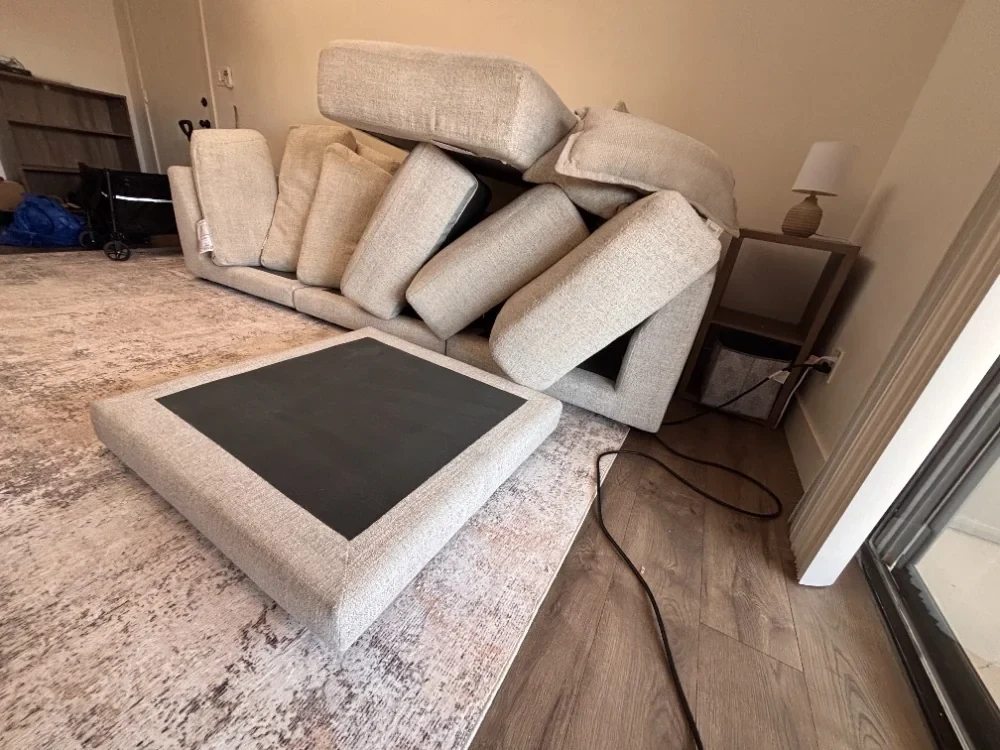
What we do instead of guessing
- Identify the fiber. By hand, by how it takes light, by how it responds to a controlled test. Natural and synthetic fibers behave differently and the difference is usually detectable.
- Look at the construction. How the piece is built tells you as much as the cloth. Hide glue, natural webbing and horsehair fill all change the answer.
- Test somewhere concealed. Under a cushion, on the back of a skirt, somewhere no one will ever look.
- Start gentle. The mildest method that could plausibly work, and escalate only when the test says it is safe.
- Stop if the test says stop. Which is the part most companies skip.
The fabrics that give us most pause
Silk
The least forgiving thing in a house. It waterspots readily, it can lose its finish and feel permanently different, and dye movement is common. On silk there is a genuine chance our answer is no, and that a textile specialist is the right call instead.
Antique and period pieces
The frame matters more than the cloth. Hide glue joints soften with moisture, natural fiber webbing weakens, and horsehair or natural fill behaves unpredictably when wetted. A beautiful nineteenth-century chair can have a cleanable fabric and an uncleanable structure.
Velvet
Cleanable in most cases, with a specific risk: crushing and pile distortion. The nap can be permanently marked by pressure or by drying unevenly, so it needs a lighter hand and more patience than the fabric suggests.
Older rayon and acetate
The classic browning candidates. Both release compounds when wetted that oxidise at the surface as the piece dries, producing a yellow-brown discoloration that is a reaction in the fiber rather than a stain sitting on it. It cannot be cleaned off afterward and it appears a day later.
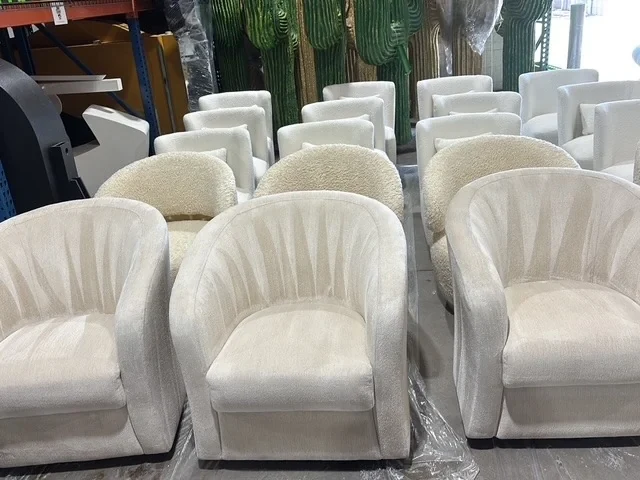
What browning actually is
Worth its own explanation because it is the failure people have usually heard about without knowing the mechanism.
Certain fibers, particularly natural ones and some older synthetics, hold compounds that dissolve when the fabric gets wet. As the piece dries, those compounds travel to the surface with the moisture and oxidise there.
The result looks like a stain and is not one. There is nothing sitting on the fabric to remove. The fiber itself has changed color, which is why it cannot be cleaned out and why it shows up after everyone has left.
It is entirely preventable by not wetting a fabric that cannot take it, which is the whole reason the identification step exists.
When we say no
It happens, and it is worth being direct about why rather than dressing it up.
If we cannot confidently identify a fabric, if a concealed test goes badly, if the construction will not tolerate moisture, or if the piece is valuable enough that the downside outweighs the benefit, we will tell you we are not the right people for it.
Losing a $127.50 job is a far better outcome than being the company that ruined a piece that could not be replaced.
Where we decline, we will tell you what we think the risk is and, where we can, point you at somebody better suited. That is not a sales technique. It is the only defensible position on furniture like this.
What helps us say yes
- The fabric name or specification if you still have it from the designer or workroom
- Any paperwork that came with an antique or a restored piece
- Knowing whether it has ever been cleaned before, and with what
- Knowing about any previous accident, including the ones somebody tried to fix themselves
- Time. A piece that needs care takes longer and costs the same
Questions
Do you clean silk?
Sometimes, and sometimes we decline. Silk is genuinely unforgiving: it waterspots, it can lose its finish, and color movement is common. On a silk piece we test first and there is a real chance the answer is that it should go to a textile specialist instead.
What about antiques?
Depends far more on the frame and construction than the cloth. Older pieces can have hide glue joints, natural fiber webbing and horsehair fill, none of which enjoy moisture. We will look and tell you honestly whether cleaning is sensible.
Why would you turn down a job?
Because on furniture worth considerably more than the cleaning, being wrong is unrecoverable. A shrunk cover, a browned arm or a bled seam cannot be undone. Losing $127.50 is a much better outcome than ruining a piece.
My piece has no care label at all.
Common here and not a problem in itself. We identify the fiber by hand, by how it behaves and by the construction, then test in a concealed spot. What we will not do is guess and proceed.
Can you clean a piece a designer specified?
Usually yes. If you still have the fabric name or the specification, bring it out, because it removes all the guesswork. Without it we identify and test as normal.
What if a previous cleaner damaged it?
Tell us what happened and what was used. Browning, rings and dye movement have different causes and different chances of improvement. Some of it responds and some of it does not, and you will get an honest read before we start.
Calls answered 7am to 8pm · same-day service usually available
An honest read on a piece costs nothing and takes a photo.